
The Service
The Welcome
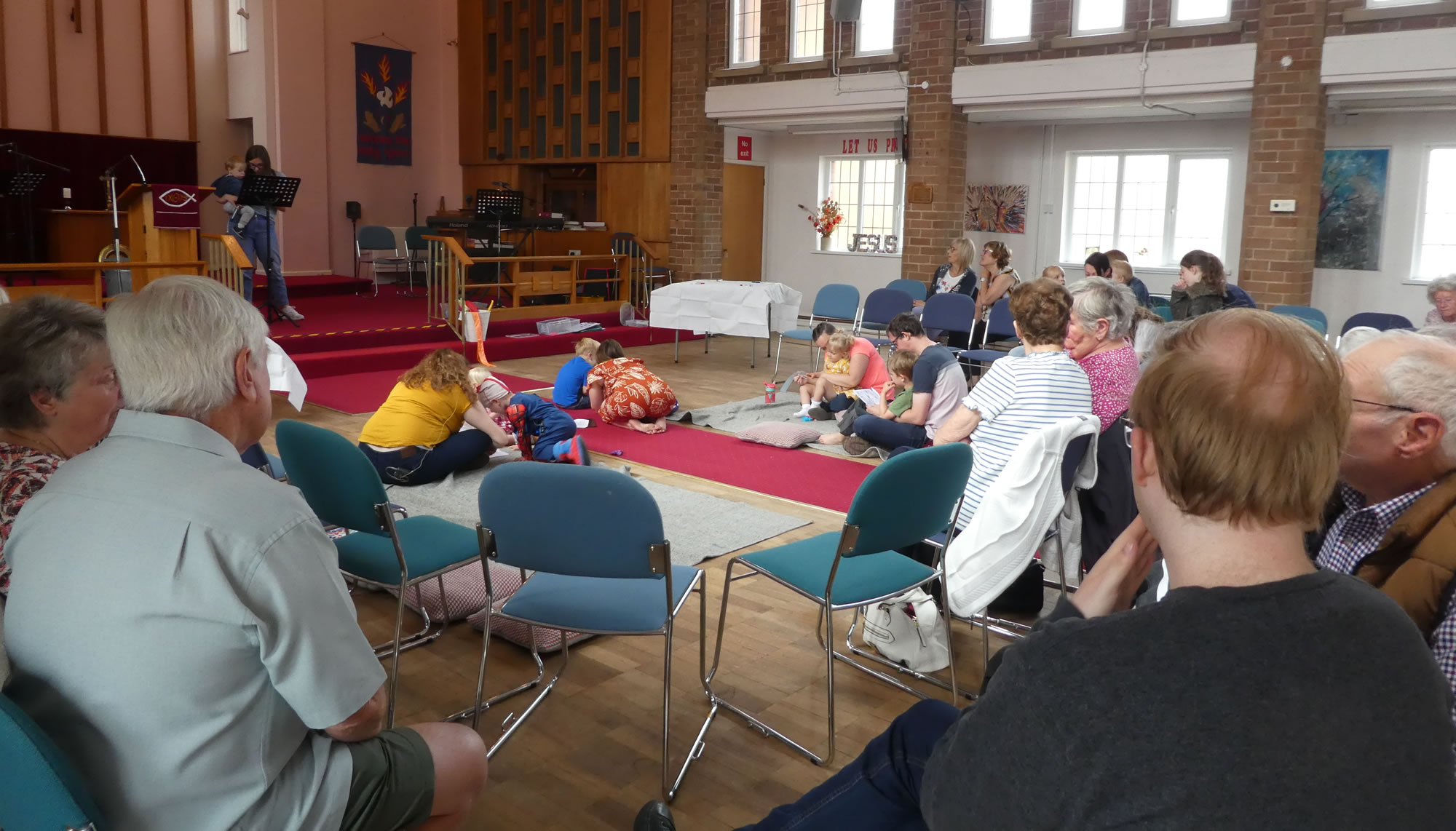
Every ENCOUNTER service starts with welcome. We also always state our mission statement, and what we aim to achieve as we worship together, putting God at the centre of all we do.
Young and old worshipping together.
Young and old learning together.
Young and old praying together.
Unity across all ages.
We also introduce the theme for the service, so everyone has an idea of what we are thinking about.
The Peace
A big part of ENCOUNTER is welcome; the idea that all people, regardless of age and ability, are invited to know God. We demonstrate this to each other at every service as we share the Ppeace. Mostly, this takes a familiar form, as we greet each other with the words “peace be with you.” Sometimes we do a “quick” peace, with a 30-second timer and a challenge to greet as many people as possible. We like to give options, so people may choose to shake hands, hug or keep a distance and greet each other using sign language.
Sometimes, we use this time differently, inviting people to chat to those around them as they consider briefly a question linked to the theme, such as “what are you thankful for?”

Music
We believe almost any worship song can be made suitable and all songs have a purpose. Using simpler songs can help children to engage with worship through music, but this doesn’t mean that they must be “kids songs.” Many traditionally “adult” songs have simple words and repetitive melodies that make them ideal for worship that is inclusive for everyone. More complex songs can be introduced in sections; for example, using just a chorus repeated several times. In our second ever ENCOUNTER service, we even used the chorus of Turn Your Eyes Upon Jesus, a hymn written in 1922!
Actions can be used as a method of teaching that we worship God with our whole body. However, they do not have to be energetic or intimidating; using elements of sign language and simple gestures makes actions accessible and they can be added to many more songs. This can also be used to explain why people behave in certain ways, such as raising their hands.
As we worship, we instruct our congregation to join in as they wish and feel comfortable. This may be standing still, sitting, dancing, raising hands, waving flags or playing musical instruments from the basket at the front. We encourage people that any way we choose to worship is valued by God.
Prayer
Prayer can be effective without being lengthy. We regularly use the model of a teaspoon of prayer (A TSP), using themes of adoration, thank you, sorry and please. Rachael and her husband now use this model to pray at bedtime with their children. We use a visual aid to go alongside this, and find even our youngest children can point at the images to choose what they wish to pray for.
Along with this, we have prayed through the alphabet, used Skittles and Magic Stars (Vanessa has a sweet tooth!), used our fingers, blown bubbles, deflated balloons, and even re-written Thank You Lord for This Fine Day. These (and others) can be found by using the creative prayer tag on our service resources.
Ultimately, prayer is about being honest with God. Any method which enables us to do this can and should be explored as we find ways in which all people can communicate and build a relationship with God.
Activity
This is the most variable part of the service and may comprise anything from a video to a game linked to the theme. We have used games such as pass the parcel, made banana split ice-cream sundaes, had a 3-legged race, blindfold obstacle courses and also more sedate activities such as sketches, puppets, quizzes and interviews.
The idea behind the activity is to help introduce the theme in a non-threatening way. One of our favourites was in the service Water Into Wine, where Vanessa put a funnel in the neck of an inflated balloon. While chatting about how God shows love for us, she added glitter to the funnel, before letting the air out of the balloon. This illustrated how extravagant God’s love is; just like glitter, it gets everywhere! Later, in the talk, Rachael expanded on this.

The Bible
As you’d expect, all our services include a passage of scripture. Mostly, we have a member of the congregation read it, with pictures on screen that help people visualise and understand the passage better. When we present the passage this way, we may check many different translations to find the one which is most accessible for our congregation.
Sometimes, we have used a dramatised re-telling of the passage; other times we have added actions for the congregation to perform or used videos that tell the story.
The Talk
At ENCOUNTER, we invite our preachers to take part in the “seven minute challenge.” We do this because it is the average attention span of a 4-year-old child. However, we often find that adults appreciate this too!
We advise that the talk should be pitched at “new Christian” level, avoiding jargon and long words. This helps engage adults while also being accessible to children.
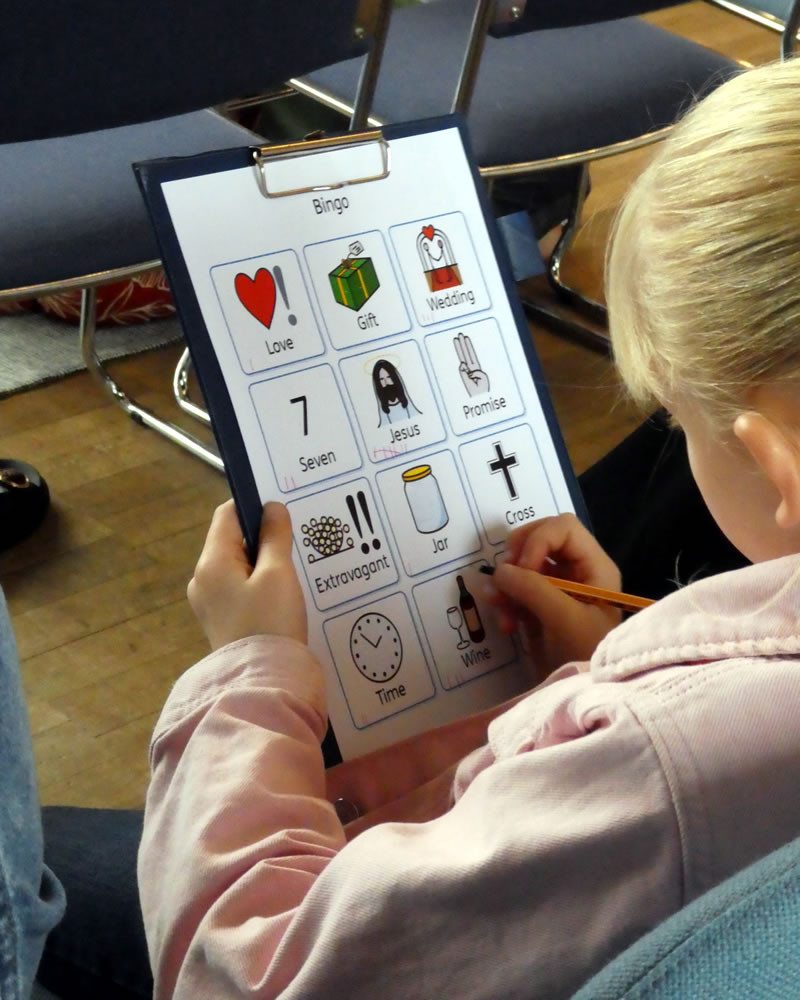
The message that God wishes us to hear is applicable to all ages, and we encourage our children to sit and listen to the talk, without the distraction of other activities such as colouring. However, we offer a bingo sheet alongside the talk, with words chosen in co-operation with the preacher. We find this helps our youngest children (and some adults too) focus on the talk as they search for the words.
We also have a basket of fidget toys which some people like to use to keep their hands busy and help them focus. Both Rachael and Vanessa can often be found at other services with a ball of yarn and crochet hook as they focus on the sermon; they don’t manage this at ENCOUNTER as they are just too busy!



Response
This is an opportunity for everyone to respond to God individually or with their family. We recognise that people worship in many different ways; the way people do this often falls into these four categories:
- Word – using spoken and written word, including Bible study, and statements of belief
- Emotion – getting in touch with inner feelings, sensing God through experience
- Action – a physical way of living spirituality
- Symbol – God experienced through images rather than words
As we plan our response activities, we look for multiple choices so that people can select the best method for them to take part in a way they feel comfortable.
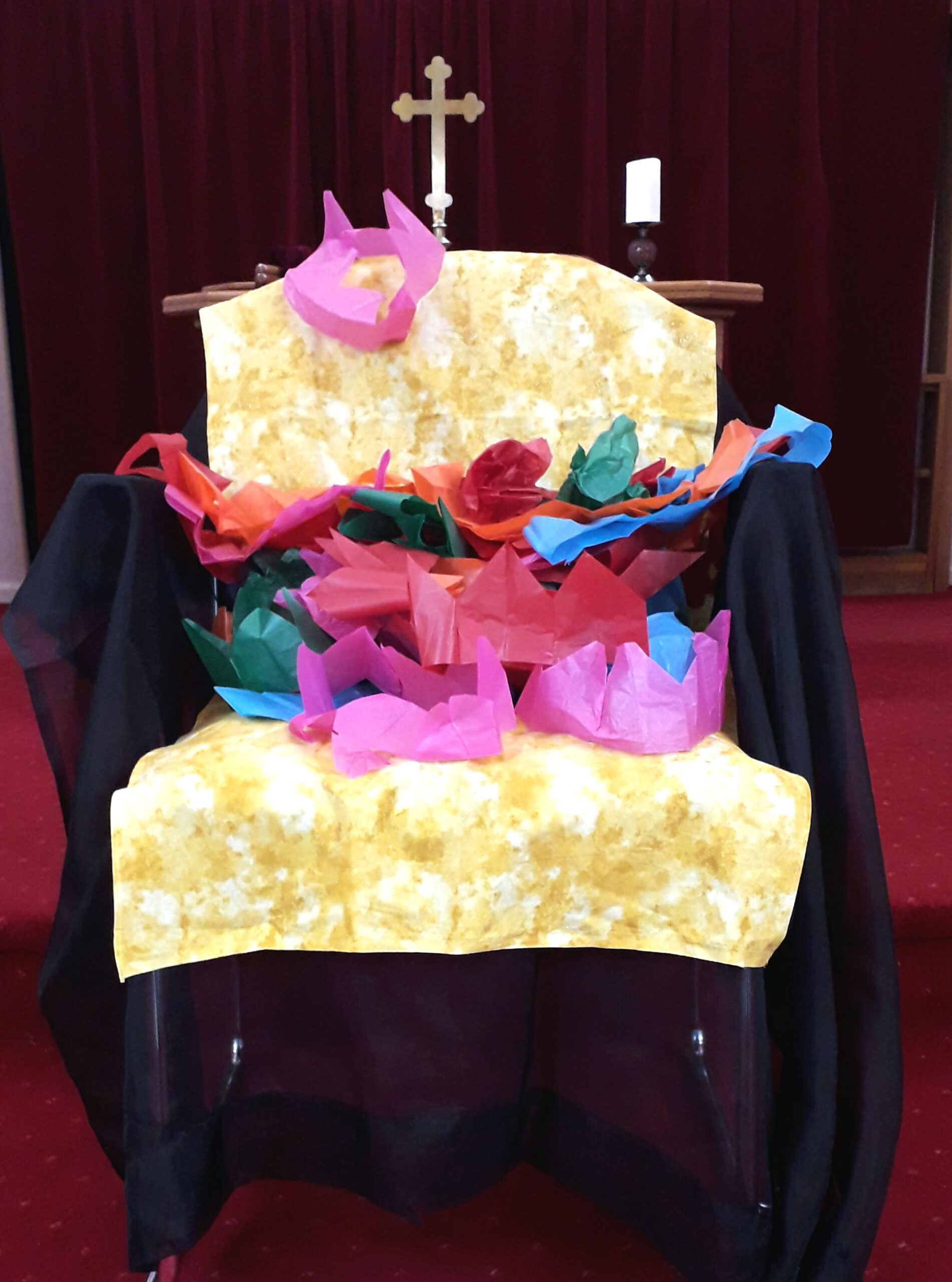
As an example, at our service on the Coronation weekend in May 2023, our theme was the ENCOUNTER The King and how all are invited to have access to Jesus the King, whereas access to King Charles is limited. Each person was given a paper crown on the way into the service. Our response options were:
- Return our crowns to Jesus, laying them on the throne at the front of church, symbolically handing over our need to be “king” in our own life and committing to make Jesus king in our own lives.
- Make an invitation to take away and give to a friend, considering who we want to invite to the King’s feast
- RSVP to an invitation to each of us from Jesus
- For our smallest children, we set up the equipment to have a tea party, with play cups, plates and food, so they could participate in their own feast.
We have also frequently taken communion in ENCOUNTER. We generally offer this as a self-serve method, with several stations around the church, each with a loaf of bread, a jug of juice and several cups. We encourage people to go as a family, or with friends and to serve each other, lingering over the communion table. We recognise that not all churches allow children to take communion, or that not all services may be led by a preacher who is allowed to preside over communion; in these cases, it may be more appropriate to use a Love Feast instead, so all can partake in God’s feast and recognise his love. More information about a Love Feast, and a short liturgy, can be found here.
Service Resources
Have you checked out our free, downloadable resources to help you plan worship yet?