
Accessibility
Environment
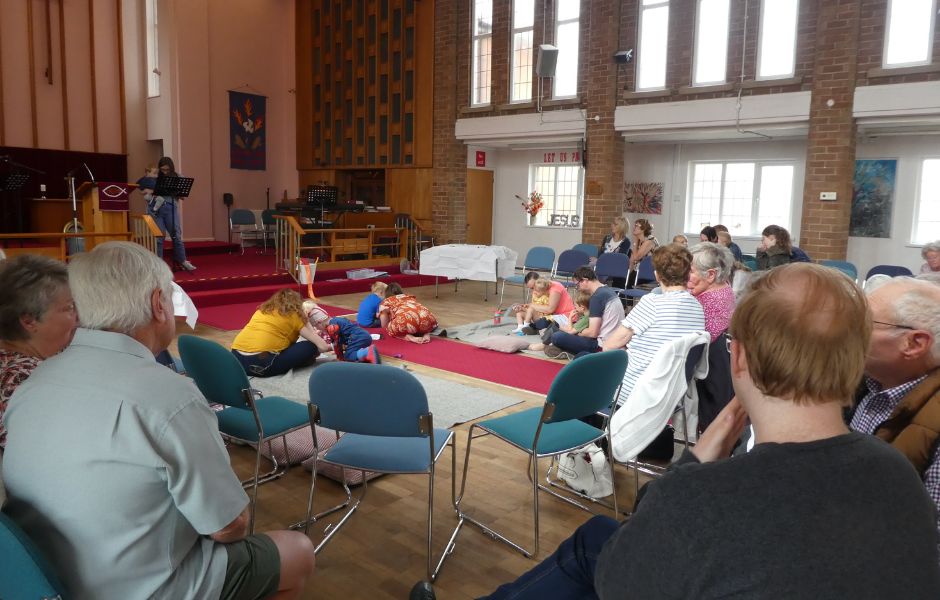
ENCOUNTER is all about inclusivity. For us, this starts with our environment. Churches can be uncomfortable places. Some things (such as pews!) we can’t fix, but others we can. For example, even the comfiest chair can be uncomfortable for children with small legs. We love to give options of how and where people sit. An area spread with blankets and cushions gives a really relaxed space where people can sit or spread out comfortably, ready to worship. Mostly, we find this is used by our families with younger children, but some of our adults like it too. Rachael, for example, much prefers to sit cross-legged than upright in a chair.
When we first started ENCOUNTER, we kept our regular chairs in their neat rows and placed blankets and cushions across the front. Then, in November 2022, we planned a service about “freedom in worship.” As we struggled to find an activity which would fit the theme, Rachael suggested “why don’t we just get everyone to move to a seat on the opposite side of the church?” It was a joke, of course, but it got us thinking. Katy suggested we try arranging the chairs differently instead. We ended up with a large horseshoe, with the blankets and cushions in the middle. Since then, we haven’t gone back. We find this layout feels incredibly welcoming and also really cements the feeling of unity as we all worship together.
This horseshoe shape may not work for you, especially if you have pews which can’t be moved. However, there are endless ways to make everyone feel welcome, so get creative.

Visual Timetable
One of the key features of ENCOUNTER is the visual timetable. Every service follows the same format, and a timetable across the screen indicates where in the service we are, and what is still to come. This is a technique often used in schools, and we find it helps our young children and those with additional needs to focus and take part in the service. We even know adults who found them the timetable helped them to participate in an active response in a way they never had before.
A huge benefit of the format of ENCOUNTER and the use of the visual timetable is that it provides predictability and a sense of safety through familiarity and routine, by removing the uncertainty of “what is coming next.” For many people with additional needs, this is essential to making church inclusive, but lots of other people like it too. We even find it helps us as leaders!
All this routine doesn’t mean it’s boring! Each element of the service can be varied, keeping things fresh. For example, the prayers can take any format, even involving chocolate! Sometimes the reading is directly from the Bible, sometimes we use a drama and we have even told the story of creation using playdough! As for the activity and the response, anything goes!
The visual timetable can be used digitally on a screen, printed on paper or even laminated, so each element can be crossed out with a whiteboard pen, helping people to keep track. We provide clothes pegs which people can move along as we progress through the service.

Social Stories
We know that, for some people, even walking into a new environment can be a huge barrier to attending church. To help with this, we have a selection of social stories, which can be used in advance of the service to help people know what to expect. These answer questions such as:
Where can I sit?
What will happen during the service?
Do I have to take part?
What happens when the service finishes?
Of course, not all people need this sort of advance planning, but for those with special needs, it can be essential in enabling them to participate. And perhaps it may be useful for someone who is new to Church; some of our practices are quite strange when you think about it!
We have a downloadable social story template that you can edit for use in your own church. This can be found here.
Movement
As we planned the very first ENCOUNTER service, we considered the format carefully, knowing that it would shape all our services moving forwards.
One of the big things we considered is the need for movement. We all know how hard it can be to sit and listen for a large chunk of time, so we intentionally planned the elements so no one has to sit still for too long.
Whether it is the opportunity to stand (and dance) for a song, or to move around for the response, there is little opportunity to get restless.
Display
If your church uses a projector, there are many ways you can make your services accessible. Have you ever talked to the people in your church who struggle with their sight? Many people will tell you that yellow text on a blue background is best, but that isn’t always true. Check with your congregation and see if there is anything that would make it easier for them.
If you are using books, make sure you have large-print editions as well. We even found a “super giant print” bible for one of our young people who needed everything printing in a very large font.
Some people with dyslexia find that using coloured overlays helps make it easier to read the words in front of them. A pack of these can be acquired relatively cheaply and may be an easy way to help them feel included. If you are using print outs or a projector, even changing the font can help. We really like the free font Open Dyslexic for this. All our website headers use this font and other writing uses Century Gothic, which is also recommended as a “dyslexia-friendly” font.

Prayer Space
We offer a quiet space at the back of our main church which people can access at any time if they feel the need to pray quietly. We all know that, sometimes, we come to church with things on our mind that distract us from worship. This space allows for people to spend time with God, offering them to him. It can also be used if anyone feels overwhelmed or like they need “time out” from the main worship.
Ours is simply made from two folding room dividers. We have a small number of chairs inside and a table with a cross and some bibles on it. We also have some battery-operated tealights, pens and paper. Sometimes we add other resources such as bible verses and prayer prompts.
If your church has the space available for this, it’s a great facility to offer. If you don’t have space in the main church, perhaps you have a porch or a side room that can be used? Please consider safeguarding as you think about how you might implement a prayer space; best practice means that no child should be in there alone with an adult (other than a parent) and anyone receiving prayer should be prayed for by two other people. If you have a semi-enclosed area like we do, then some of those concerns are eased because there is always visibility.

Other Considerations
You know your congregation better than we do, so please talk with them about how you can make your services accessible for everyone. What works for us may not work for you, and what works for one person may not help the person sat next to them. Through conversation, you can make attending church and worshiping God a positive experience for everyone.